
So what is breath and ice therapy?
By 2019, I was completely captivated by the Wim Hof Method. As his signature breathing and ice therapy techniques began gaining massive traction on social media, I found myself diving deep into the rabbit hole—watching countless videos, scouring Wim’s website, and following every update with intense curiosity.
My partner and I started practicing the techniques at home, doing our best to replicate the instructions we found online. Our interest eventually grew into a full-blown obsession, prompting us to plan a trip to Europe. While the itinerary included catching up with long-lost friends across various countries, the true highlight for me was a pilgrimage to the source: I booked a two-day immersion at the Wim Hof base camp in the Netherlands.
Wim Hof Method Advanced Course Day 1.
The long-awaited weekend of May 25th finally arrived. My partner and I had flown into the Netherlands, eager to take part in a Wim Hof Method course led by master instructors Bart Biermans and Dominique Stuhlen. Having studied Wim’s videos and practiced the breathing techniques for several months, we felt ready—or so we thought.
It was a beautiful, sunny 17°C day when we pulled up to the Wim Hof Centre in Stroe. We were greeted warmly by Zsolt Varga, who worked tirelessly behind the scenes to ensure every detail was perfect. Then, seemingly out of nowhere, Wim Hof himself appeared. Dressed in a vibrant explosion of mismatched, multicolored clothes and radiating pure energy, he possessed an electric, charismatic demeanor that immediately fired up the entire group.
The Introduction Game
The first day kicked off with twenty-six eager participants representing ten different countries. To break the ice, the instructors gathered us into a large circle for an introduction game with increasingly high stakes.
The first person had to recite both instructors’ names followed by their own. The second person then had to repeat the instructors’ names, the first participant’s name, and then introduce themselves. This pattern continued, person by person, around the circle. By the time the rotation reached me, I had sixteen names to recall in perfect order.
The penalty for a memory lapse? An immediate trip to the ice bath without any of the mental or physical preparation we were there to learn. To this day, I’m still not entirely sure how I managed to pull it off, but I recited all sixteen names flawlessly—and stayed dry for the time being.
The Science behind the Cold
Following the introductions, we dove into the theory behind the Wim Hof Method (WHM). We were presented with the scientific evidence that validates the practice—results from rigorous testing conducted not just on Wim himself, but on his instructors as well.
For decades, the medical establishment maintained that the “fight-or-flight” response was an involuntary function of the autonomic nervous system, entirely beyond our conscious control. However, these test results challenged that long-held belief. We reviewed data showing how WHM practitioners could intentionally shift from a sympathetic (stress) state to a parasympathetic (rest and recovery) state using nothing more than breath and focused intent.
Brain scans provided even more fascinating insights, particularly regarding the insula—the region responsible for perceiving bodily sensations like pain. We saw evidence of Wim’s ability to effectively “switch off” this area while activating other regions to calm the body’s physiological response. Most impressively, we examined data where practitioners sat in ice water for over sixty minutes while maintaining a stable core temperature. By utilizing specific breathing and mental techniques, they were able to keep their circulatory systems open—pumping warm blood to their extremities and overriding the body’s natural instinct to shut down during extreme cold exposure.
Training begins with Breath
Then, it was time to begin the training. We lay on yoga mats across the hall and, following the instructor’s lead, began breathing in a rhythmic, specific pattern: drawing in deep, expansive breaths to fill the lungs to capacity, then simply letting the air “fall” out rather than forcing it. After forty repetitions, we exhaled and entered the retention phase, holding our breath for as long as possible. Once the urge to breathe became too strong, we took a full recovery breath, held it for fifteen seconds—visualizing the blood being directed toward the head—before exhaling and beginning the next round. We completed three rounds in total.
As I understood it, the objective of this technique is twofold. First, the active breathing phase saturates the blood with oxygen and shifts the body into a temporary alkaline state. This process intentionally triggers the sympathetic nervous system (fight-or-flight), increasing the heart rate and inducing a controlled release of cortisol and adrenaline.
Second, the retention phase challenges the body by depleting oxygen levels while maintaining a state of deep mental calm. This stillness facilitates the switch to the parasympathetic nervous system. By significantly decreasing carbon dioxide levels during the active breathing phase, the blood’s pH increases—a shift that occurs because hemoglobin is able to bind more effectively with oxygen, optimizing the body’s internal chemistry before the cold exposure begins.
The Ice Bath
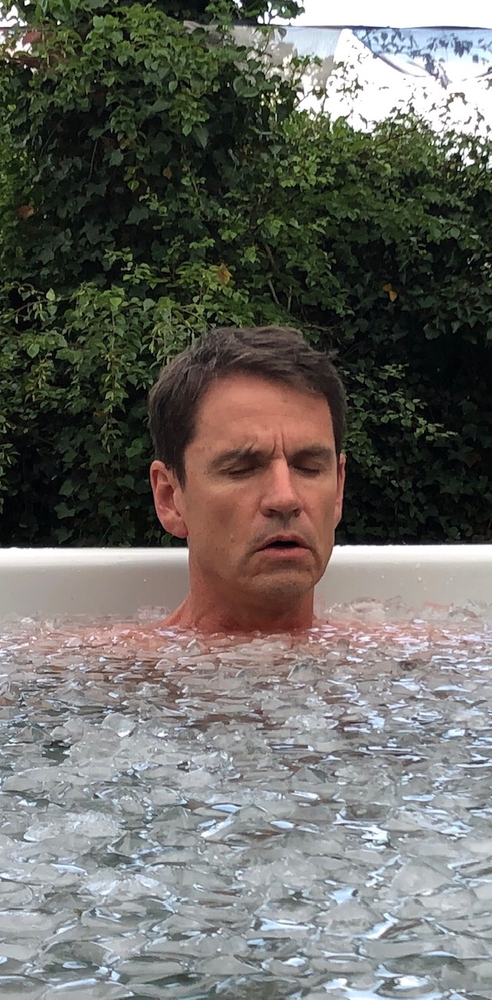
Then came the moment of truth: the ice bath. Zsolt, our tireless coordinator, had prepared a large tub filled with ice cubes, designed to accommodate eight of us at a time. The water temperature was clocked at a brisk 1°C—simply wonderful. My enthusiasm was so high that I practically sprinted to the tub to ensure I was in the first group. In fact, I was the very first person standing at the edge, ready to plunge in.
Our instructor, Bart, guided us through the entry process. As we submerged ourselves up to our necks in the slush, we were instructed to place our hands over our chests, covering our hearts. Immediately, my body went into a state of shock. My brain screamed at me to get out, and I could feel a stinging, biting pain radiating across my skin.
Bart’s voice remained calm, controlled, and deeply reassuring. Following his lead, I focused entirely on my breath, anchoring myself with relaxing thoughts. I kept a silent mantra running through my mind: “Relaaaaaaaaax… the cold is my friend.” After the first minute, the shivering stopped. A sudden wave of composure washed over me; I felt in total control of both mind and body. I began to feel an internal heat generating from within, replacing the sensation of the bitter cold against my skin. My heart rate slowed, my breathing deepened, and I slipped into a profound, meditative state—a place where time and fear seemed to vanish.
While my body had initially spiked into a sympathetic “fight-or-flight” response, flooding my system with adrenaline and cortisol, I had successfully pivoted. By activating my parasympathetic nervous system, I had returned to a state of total equilibrium in the midst of the ice.
The Exercises
After two minutes, the signal came to exit. As I climbed out, my skin was glowing a deep, vibrant red wherever the ice had touched it. I felt completely supercharged—as if someone had plugged me into a high-voltage power source. I felt incredibly alive and in total awe of what had just occurred. “What an absolute rush,” I thought to myself.
Dominique then led us to a grassy area nearby for the “warm-up” phase. We moved through a series of intentional, strenuous exercises designed to kickstart our circulation. These movements lasted about ten minutes and were far from optional. We were taught that without this active recovery, the cold blood trapped in our extremities could rush back toward our core too quickly—a phenomenon known as “afterdrop”—which can cause the core body temperature to plummet and potentially lead to hypothermia. The exercises weren’t just a workout; they were a vital part of the safety protocol to bring the body back to equilibrium.
Bare foot in the forest
After a wonderful vegan lunch—which shattered my preconceptions about how flavorful plant-based food could be—it was time to shed our shoes for a mindful walk into the forest. We were instructed to remain in total silence, shifting our focus toward a deep sensory awareness of the present moment.
As we walked barefoot up the road and into the trees, I focused on the texture of the earth underfoot and the warmth of the sun on my skin. I became acutely tuned into the rustle of the trees, the calls of the birds, and the rhythmic flow of my own breath and movement. Once we reached a secluded clearing deep in the forest, we gathered to perform three rounds of the breathing technique in a seated position. We finished the session in stillness, simply observing the interplay between body and mind while feeling completely anchored in our environment.
The intensity is increased
After the break, we dove back into the theory before beginning the next round of breathwork: 40 breaths across six cycles. Accompanied by solfeggio frequencies and a rhythmic drumbeat that kept us in perfect sync, the pace gradually quickened. Each cycle became more intense, and the retentions grew longer.
Although the instructors suggested a limit of two minutes, I felt a pull to go beyond my usual boundaries, holding my breath for upwards of three minutes at a time. My body became a landscape of rushing sensations—a vibrant tingling that reached every limb. I was truly “high on my own supply.” By the final round, as we lay in the stillness, a profound sense of calm took over. My breathing became so slow and shallow it was almost imperceptible. In that space, I felt an overwhelming surge of love, strength, and a deep sense of oneness with everyone in the room. We were eventually invited to return to the present and rise in our own time.
Togetherness
What followed was nothing short of extraordinary; a collective sense of awe settled over all twenty-six of us. The room erupted into warmth as strangers began to embrace, faces lit with genuine smiles as they shared their journeys. It felt as though we had all shared a dose of some euphoric elixir, yet our only “drug” was oxygen. There were tears, too—some were finally releasing emotional blocks they had carried for years. As I watched the room transform, a single thought took hold: This is a once-in-a-lifetime experience.
My body overpowered my mind
Then it was time to go back to the ice bath. This time we would submerge ourselves in the ice for 2 minutes, get out, do the exercises for 5 minutes, then get back in the ice for 2 minutes. We did this routine 6 times. Then we were all ushered from the bath and out to an area of a large circular room. By this time, we were all freezing cold. All 26 participants were shivering, some were delirious, not being able to string sentences together. I was shaking uncontrollably. My body had overpowered my mind.
Bart and Dominque took us through many exercises including push ups to warm us up again. It was like the life had been drained out of me. I was physically and mentally exhausted, my body was aching with pain. I suddenly found the other side to the Wim Hof coin. It wasn’t all roses and sweet dreams. My body had won this time.
Bonding like no other
Then it was the end of the training for the day. We all hurriedly made our way to the hot sauna and or spa which were prepared for us. Oh, what a joy, the warmth, finally, to sit crammed in, practically on top of each other. Chatting about our experiences, laughing, and enjoying each other’s company. It was as if we had all know each other for years, best of friends. Folks from all corners of the world shoulder to shoulder, legs over legs, and such a strong sense of oneness.
Wim Hof Method Advanced Course Day 2.
The morning was overcast, and the temperature had dropped about five degrees from the day before. Yet, the morale remained high; all twenty-six of us were still there, and not a single person had packed up or headed home. I felt completely fired up—fueled by an intensity that made me want to push my limits as hard as possible. We began with the theory behind the practice, learning the science of how cold therapy can combat inflammation and even support the healing of conditions like rheumatoid arthritis.
Mark losses control
Then, it was back into the practice for another six rounds. I was fully locked into the rhythm, my focus anchored by the sound of my new friend, Mark, breathing just inches away from me. Without words, our synchronized inhalations and exhalations pushed us both further. My body was vibrating, saturated with oxygen; my head was swimming in a state of pure euphoria.
Suddenly, a sharp thump to my head broke the spell, followed quickly by another. I opened my eyes to find Mark’s arms flailing uncontrollably. I called his name, but there was no response—he was physically there, but his consciousness had drifted away. It seemed as though he had stopped breathing entirely. The instructors rushed to his side, grounding him with their touch and calmly guiding him back to a slow, steady breath. Once I saw he was safe, I closed my eyes and returned to my own practice.
When the six rounds ended, we slowly sat up. I turned to Mark and asked if he was okay, explaining the shock he’d given me, but he only looked back at me with a puzzled expression. He had no memory of the event at all. It was a sobering realization: as powerful as this practice is, there is a real danger in pushing too far, too fast. I understood then that we must respect the process and build our practice with patience and care.
Go harder and longer
We returned to the ice bath, but the stakes were higher now: five minutes in the freezing depths. I felt motivated, yet I chose to watch one group go before me, mentally preparing for the plunge. As I submerged, a massive rush of adrenaline kicked in. My body immediately went into shock, sending frantic signals to my brain: What are you doing? Have you lost your mind? Get out now!
The instructor, Bart, was speaking, but his voice was a distant murmur; I was entirely consumed by the war raging between my body and mind. Slowly, my racing heart and gasping breath began to steady. As my body relaxed, the piercing cold was replaced by an unexpected warmth. Reaching into my own toolkit, I began to use a mantra meditation I teach my students, chanting “Ohm” over and over. My fellow participants joined in, and the collective sound pulled me back into consciousness.
Suddenly, Wim Hof appeared at the edge of the bath, joining our chant. The resonance grew louder as Wim began to sing and dance, shouting, “Enjoy the experience!” before breaking into a spirited rendition of “Who Let the Dogs Out.” The atmosphere shifted instantly from a trial to a party. Participants gathered around the tub, Wim’s dog began barking along, and the volume reached a fever pitch. We were all completely electric. Bart started the countdown from ten, and we screamed every number until we hit zero. We emerged from the water, embracing one another in a state of pure, unadulterated euphoria. What a rush! I actually have a video of this event. https://youtu.be/1HxL67sepqA
I had pushed too hard again
After the bath, we moved back inside to warm up with yoga, more theory, and another round of euphoric breathing. Then came the final challenge. While Wim himself slipped into the ice—where he would remain for over sixty minutes—we were tasked with submerging only our hands and wrists for a maximum of twenty minutes. True to form, I was one of the first at the water’s edge. As the minutes ticked by, the circle began to thin. One by one, participants pulled their hands from the slush; some tried again, while others surrendered to the cold. I pushed on.
Soon, the cold transitioned into a searing, serious pain. My fingers throbbed, and I found myself locked in another battle against my body’s instinctual urge to retreat. I persisted even as a wave of nausea washed over me. “Relax, only three minutes to go,” I whispered to myself. When the twenty-minute mark finally arrived, I pulled my hands out and turned toward the decking to begin my recovery exercises. Suddenly, the world spun. Dizziness took hold, and I had to lie down as my body finally decided to shut me down. An instructor rushed to my aid, and after a few minutes, the color began to return to my face. Once again, I had found the limit—and pushed right past it.
It’s a wrap
In reflection, this was one of the most profound experiences of my life. I discovered that while my mind is incredibly strong—capable of pushing my body to its absolute limits—I also learned the importance of respecting those limits. During one of the breathing rounds, my body shook so uncontrollably that I briefly lost consciousness. Rather than being frightened by the lapse, I felt motivated by the sheer power of the practice.
It has been two months since that monumental workshop in Stroe, Netherlands, and the Wim Hof Method is now a cornerstone of my daily life. Every morning involves breathing exercises and a cold shower, with a full ice bath once a week. The results have been incredible: I sleep soundly, wake up refreshed, and have noticed a significant boost in my strength and endurance. While those around me have struggled with the flu, my immune system has remained resilient. Long-standing ailments are finally losing their grip on my wellbeing. Without changing anything else in my life, I have seen undeniable proof that this method works. I am deeply committed to this practice; life is good.
At its core, the WHM is about consciously switching off the “fight or flight” stress response, training the body and mind to remain calm and centered even in the midst of extreme conditions.You may also like to read;
Panic Attack , The Power of Meditation , Matrix Therapy , 10 Day Meditation Course Part 1 , 10 Day Meditation Course Part 2
Take Action Now
You can also give me a call for a free 15 minute chat to see if my service is right for you 0405 391 110 or fill out the contact form: Contact Form
Check out my social pages:
Learn more About Adrian Spear